
If you’re coming from English, Azerbaijani word order is going to feel a little backwards at first. And I mean that literally because the verb goes at the end.
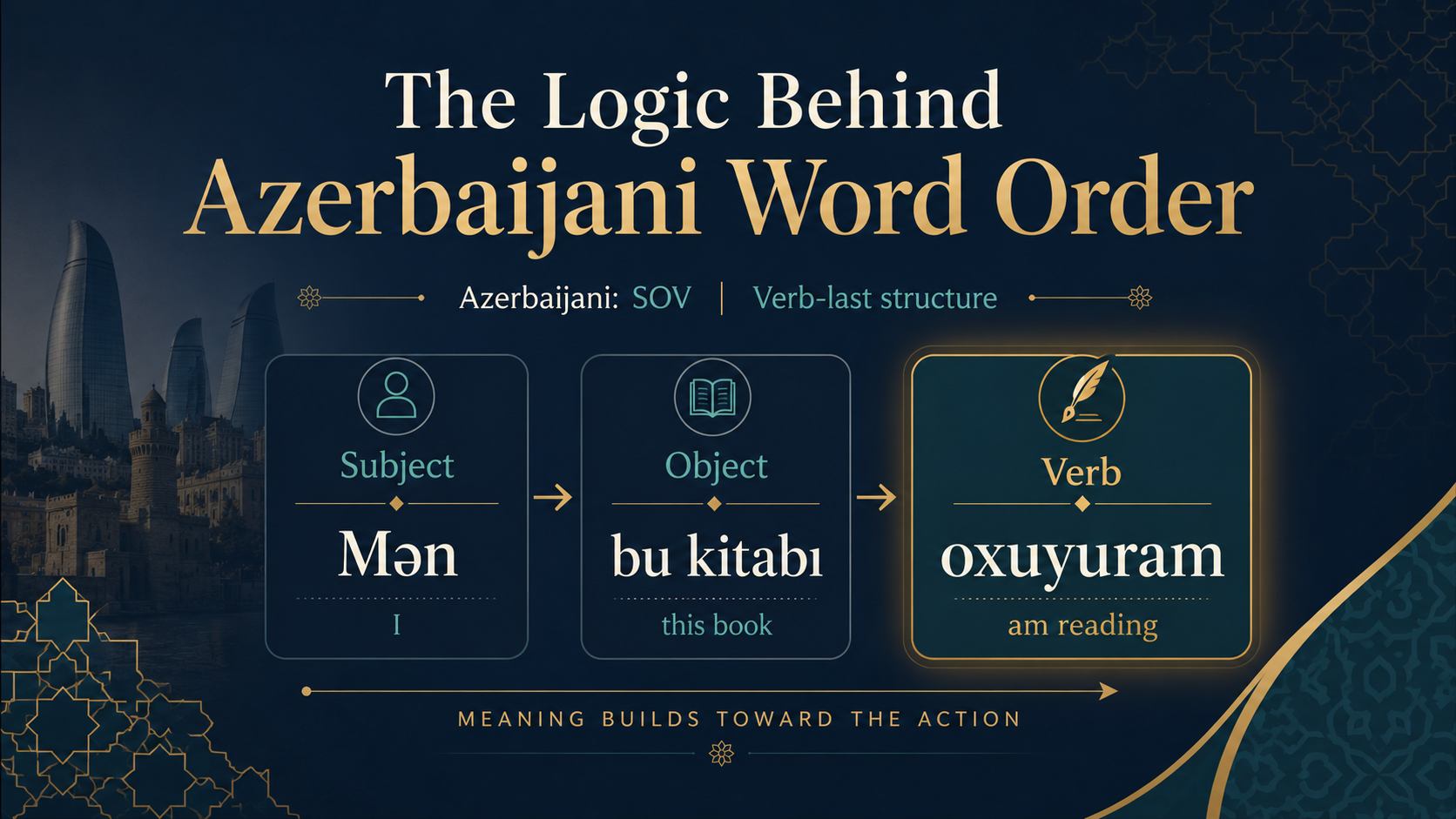
In English you say: “I am reading this book.” In Azerbaijani, it’s: “Mən bu kitabı oxuyuram”, which unpacks as something like “I this book reading am.”
Your instinct might be to treat this as a quirk to memorize, but it’s not random. There’s a real logic to it, and once you see it, Azerbaijani sentences start to feel almost satisfying.
Why does the verb go last?
Azerbaijani is what linguists call a head-final language. The “head” of the sentence, the main verb or the action comes at the end, after everything else has been set up. Think of it like building a sentence rather than blurting one out. You introduce who’s involved, what’s being acted on, and then, once the listener has all that context, you deliver the action.
It’s a different rhythm from English, where we get to the verb almost immediately. Neither approach is more logical; they’re just different bets on when to give the listener the key information.
Why word order is flexible (and why that’s not chaos)
Here’s where it gets interesting. Azerbaijani is agglutinative, meaning it packs a huge amount of grammatical information into suffixes. The ending on a word already tells you whether it’s the subject, the object, what tense you are using, and sometimes even meaning that English would need extra words to express things English doesn’t even have a word for. Because of that, the language doesn’t need strict word order to keep things clear; the suffixes are doing that job.
So while Subject–Object–Verb is the default, speakers move things around all the time, and this is one of the places where spoken Azerbaijani starts to drift from what the textbooks show you. Putting the object first gives it more weight. Moving something right before the verb emphasizes it. This isn’t breaking the rules; it’s using the language the way it was designed to be used.
Compare that to English, where I called you and You called me only stay clear because of word order. Flip the words, and you’ve lost the meaning. In Azerbaijani, zəng etdim means “I called,” and zəng etdin means “you called”. The suffix does that job, so the words around it can move freely.
What this means for learners
The main trap is trying to translate sentence by sentence from English, and it goes deeper than just word order. English relies on order; Azerbaijani relies on endings. If you want to understand why that shift is so hard to make, thinking in Azerbaijani rather than translating from English is worth reading alongside this.
Once you shift your focus to the suffixes and stop fighting the verb-last structure, things start clicking.
The pattern to internalize is simple:
- Mən bu kitabı oxuyuram. - I / this book / reading am.
- O, çayı içdi. - He or she / the tea / drank.
- Sən Bakıya gedirsən? - You / to Baku / going are?
Verb at the end, every time. Train your ear to wait for it, and Azerbaijani sentences will start to feel complete rather than strange.
The language is building up to something. You just have to let it.
Practice Sentence Structure Step by Step
Azerbaijani word order starts making sense when you stop translating directly from English and begin noticing the structure underneath: subject, object, suffixes, and the verb at the end.
The Master Azerbaijani app starts with the foundations, then builds toward real phrases, pronunciation, grammar, cultural context, and everyday communication step by step.