
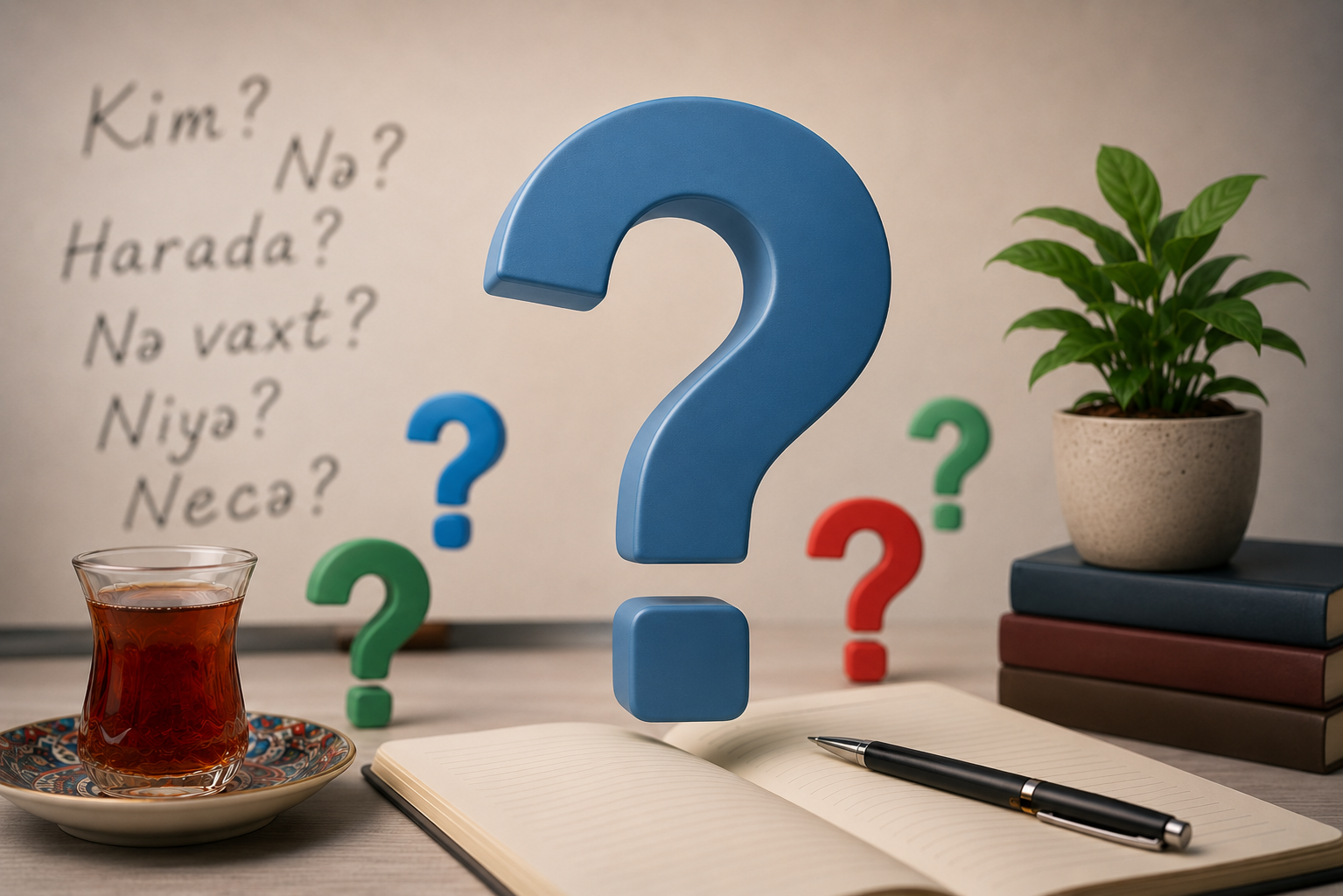
In English, turning a statement into a question requires rearranging the sentence.
She is coming. → Is she coming?
You speak Azerbaijani. → Do you speak Azerbaijani?
The verb moves. An auxiliary appears. The word order shifts.
Azerbaijani does none of this.
Questions in Azerbaijani are built by adding something to the end of a sentence, or by placing a question word exactly where the answer would go. The sentence structure stays intact. Nothing moves.
Once that clicks, questions become one of the easier parts of the language.
Yes/No questions: one particle does all the work
There are two ways to turn a statement into a yes/no question in Azerbaijani, and both are correct.
The first is adding the particle -mı / -mi / -mu / -mü to the end. Which form you use depends on vowel harmony; the particle matches the last vowel in the word before it.
The second is simply raising your intonation. The sentence stays identical to the statement. The question is in the voice, not the words.
Gəlirsən. - You are coming.
Gəlirsənmi? - Are you coming? OR Gəlirsən? - Are you coming?
Both are used in everyday speech. The particle is more explicit and works well in writing or when you want to be unambiguous. Intonation is common in casual conversation.
Danışır. - He is speaking.
Danışırmı? - Is he speaking? OR Danışır? - Is he speaking?
Oxudun. - You read.
Oxudunmu? - Did you read? OR Oxudun? - Did you read?
Gördün. - You saw.
Gördünmü? - Did you see? OR Gördünmü? - Did you see?
No rearranging. No auxiliary verb. The statement stays exactly as it is, and the particle at the end signals that you are asking, not telling.
The particle can also attach to a noun or adjective in the sentence to ask specifically about that element. Again, intonation alone works just as well.
Ev böyükdür. - The house is big.
Ev böyükdürmü? - Is the house big? OR Ev böyükdür? - Is the house big?
O müəllimdir. - She is a teacher.
O müəllimdirmi?** - Is she a teacher? OR O müəllimdir? - Is she a teacher?
When using the particle, it follows vowel harmony like every other suffix in the language.
Question words: go where the answer would go
Azerbaijani question words slot into the position that the answer would occupy in the sentence. This feels unusual at first, but it is actually more logical than English once you see it.
The main question words:
Nə? - What?
Kim? - Who?
Harada? / Hara? - Where?
Nə vaxt? - When?
Niyə? / Nə üçün? - Why?
Necə? - How?
Neçə? - How many? / How much?
Hansı? - Which?
They take case suffixes just like nouns do. This is where English speakers sometimes get stuck; they treat question words as fixed forms and forget that they decline.
Kim gəldi? - Who came? (nominative - the question word is the subject)
Kimə dedin? - Who did you tell? (dative - told to whom)
Kiminlə danışdın? - Who did you speak with? (with whom)
Kimdən eşitdin? - Who did you hear it from? (ablative - from whom)
The same applies to nə:
Nə istəyirsən? - What do you want?
Nəyi itirdin? - What did you lose? (accusative - specific object)
Nədən danışırdılar? - What were they talking about? (ablative)
And to hara:
Hara gedirsən? - Where are you going? (direction - no suffix needed here)
Harada yaşayırsan? - Where do you live? (locative)
Haradan gəlirsən? - Where are you coming from? (ablative)
The question word bends to fit its role in the sentence. Once you are comfortable with case endings, this becomes straightforward. If cases are still new, Understanding Azerbaijani Cases: A Practical Approach is worth reading alongside this.
Word order stays the same
This is the part that surprises English speakers most.
In English, questions often require inverting the subject and verb. In Azerbaijani, nothing inverts. The question word goes where the answer would be, and everything else stays in place.
Statement: Anar kitabı oxudu. - Anar read the book.
To ask who read it: Kim kitabı oxudu? - Who read the book? (Kim replaces Anar in subject position)
To ask what he read: Anar nəyi oxudu? - What did Anar read? (nəyi replaces kitabı in object position)
To ask when: Anar kitabı nə vaxt oxudu? - When did Anar read the book? (nə vaxt slots in before the verb)
The verb stays at the end. The subject stays at the beginning. The question word takes the place of the unknown information. That is the whole system.
A few questions worth memorizing early
Some question phrases are so frequently used that having them ready without thinking is worth the effort.
Necəsən? - How are you? (informal)
Adın nədir? - What is your name?
Bu nədir? - What is this?
Bu neçəyədir? - How much is this?
Harada? - Where?
Niyə? - Why?
Başa düşdünmü? - Did you understand?
Bilmirəm, siz bilirsiniz? - I don’t know, do you know?
That last one is more useful than it looks. Not knowing and being able to ask is a real conversational skill.
Questions are how conversations stay alive
Knowing how to ask questions is not just a grammar exercise.
It is what keeps a conversation going when your vocabulary runs out. A well-placed niyə? or necə? can carry you further than ten new words. And in Azerbaijani, where the structure is this consistent, questions are one of the fastest things to make automatic.
Learn the particle. Learn the question words with their cases. Notice where the question word sits in the sentence.
The rest follows from there.
Practice Real Conversations
Questions are where passive study meets active use. The Master Azerbaijani app builds toward real back-and-forth communication step by step, starting with the foundations.