
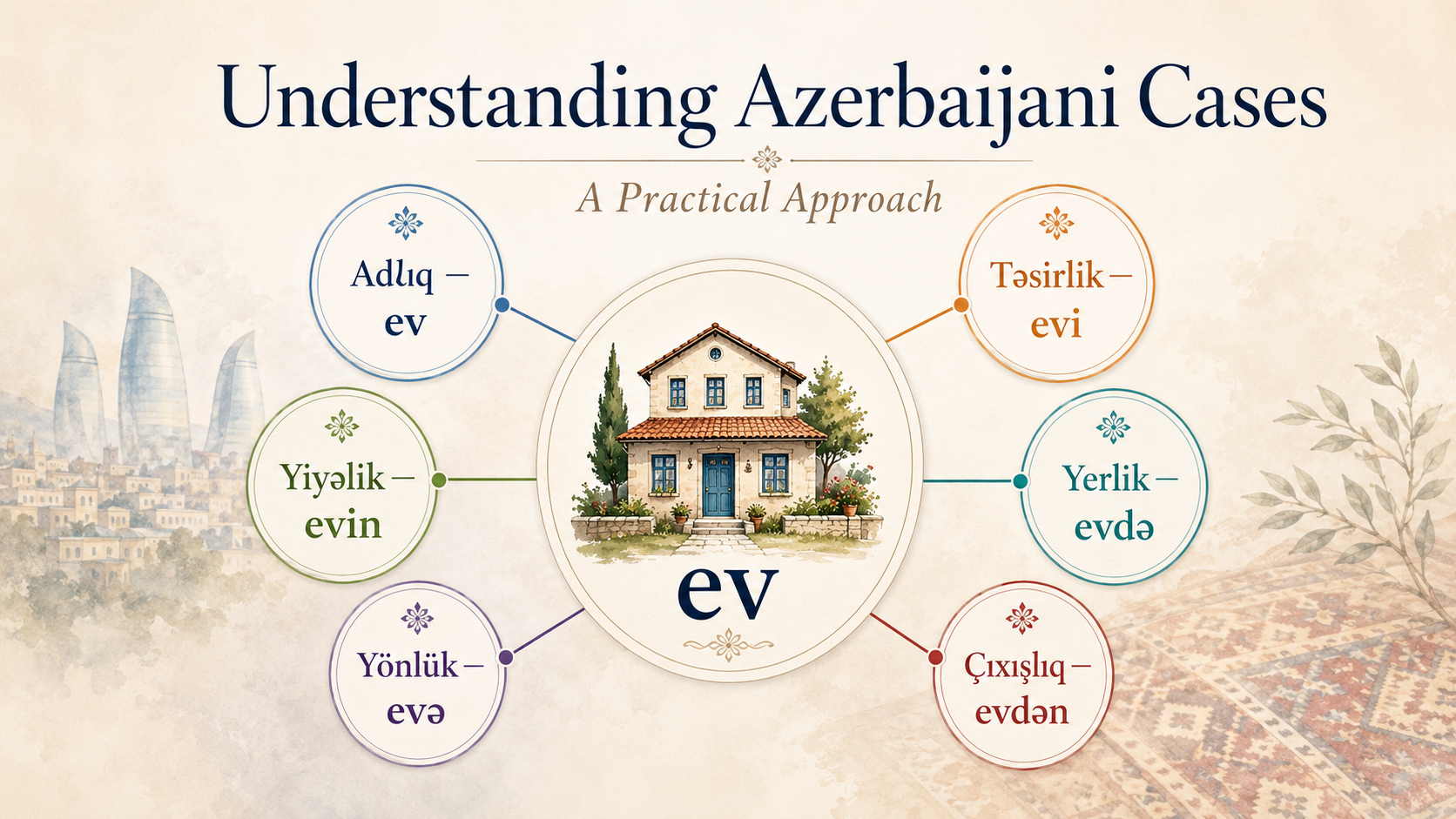
Cases are a part of Azerbaijani grammar that English speakers find most unfamiliar.
English does not use noun cases in the same way. The noun house stays house whether you are talking about it, going to it, leaving it, or saying it belongs to someone. Context and prepositions do the work instead.
Azerbaijani assigns that work to suffixes on the noun itself. Each case tells you what role the noun is playing in the sentence. Once you understand the logic behind each one, not just what suffix it uses, but what question it answers, the system starts to feel less like memorization and more like a tool.
Azerbaijani has six cases. Here is each one, what it does, and when you reach for it.
Adlıq hal: Nominative case
The base form. No suffix added.
The nominative is the subject of the sentence: the person or thing doing the action, or the topic being described.
Ev böyükdür. → The house is big.
Uşaq oxuyur. → The child is reading.
Kamran müəllimdir. → Kamran is a teacher.
When you look up a word in the dictionary, you are seeing its nominative case (adlıq hal) form. It is also the form you use when the noun is simply being named or identified, with no movement, possession, or relationship to express.
Yiyəlik hal: Genitive case
The genitive marks possession or belonging. It answers the question: whose? or of what?
This is where Azerbaijani makes a distinction that English does not: definite and indefinite genitive.
Definite yiyəlik / müəyyən yiyəlik: the possessor is specific and known.
The possessor takes the suffix -(n)ın / -(n)in / -(n)un / -(n)ün, and the possessed noun takes a possessive suffix matching it.
uşağın kitabı → the child’s book (that specific child)
dostumun evi → my friend’s house (a particular friend)
şəhərin mərkəzi → the city center (of this city)
Indefinite yiyəlik / qeyri-müəyyən yiyəlik: the possessor is general or unspecified.
No genitive suffix on the possessor. The relationship is implied.
uşaq otağı → a children’s room (a room for children in general)
çay stəkanı → a tea glass (a glass for tea, not belonging to a specific tea)
dil kursu → a language course
The difference matters. Uşağın otağı is the room belonging to a specific child you both know about. Uşaq otağı is a children’s room in the general sense.
Yönlük hal: Dative case
The dative marks direction or destination. It answers: to where? or for whom?
Suffix: -a / -ə
Mən evə gedirəm. → I am going home.
Bazara get. → Go to the market.
Dostuma zəng etdim. → I called my friend. (to my friend)
Sənə dedim. → I told you. (to you)
Any time something moves toward a place or a person, the dative is what you need. It also appears with certain verbs that carry an inherent sense of direction: calling someone, giving something, saying something to someone.
If you have been dropping this suffix in speech, Common Grammar Mistakes English Speakers Make in Azerbaijani covers why that happens and how to fix it.
Təsirlik hal: Accusative case
The accusative marks the direct object of a verb: the thing the action is done to.
Like the genitive, Azerbaijani makes a definite/indefinite distinction here, and this one trips up learners consistently.
Definite təsirlik / müəyyən təsirlik: a specific, known object.
Suffix: -(y)ı / -(y)i / -(y)u / -(y)ü
Kitabı oxudum. → I read the book. (that specific book)
Suyu içdi. → He drank the water. (the water that was there)
Onu gördüm. → I saw him/her.
Indefinite təsirlik / qeyri-müəyyən təsirlik: an unspecified object. No suffix.
Kitab oxudum. → I read a book. (any book, unspecified)
Su içdi. → He drank water. (water in general)
Film gördüm. → I saw a film.
The suffix signals definiteness. Its absence signals indefiniteness. This is the same distinction English makes with the versus a, but in Azerbaijani it lives on the noun rather than in a separate article.
When in doubt: if you could say the in English, use the accusative suffix. If you would say a or nothing at all, leave it off.
Yerlik hal: Locative case
The locative marks location. It answers: where?
Suffix: -da / -də
Evdə otururam. → I am sitting at home.
Məktəbdə oxuyur. → She studies at school.
Bakıda yaşayıram. → I live in Baku.
Stəkanda su var. → There is water in the glass.
Any time something exists at or in a place, the locative is what marks it. Static location; not movement toward or away from, just presence.
Çıxışlıq hal: Ablative case
The ablative marks movement away from a place, or origin. It answers: from where?
Suffix: -dan / -dən
Evdən çıxdım. → I left the house.
Bakıdan gəlirəm. → I am coming from Baku.
Dostundan eşitdim. → I heard it from your friend.
Stoldan götür. → Take it from the table.
The ablative and the locative are often learned together because they are mirror images: -da / -də is being somewhere, -dan / -dən is coming from somewhere.
Evdəyəm. → I am at home. (locative)
Evdən gəlirəm. → I am coming from home. (ablative)
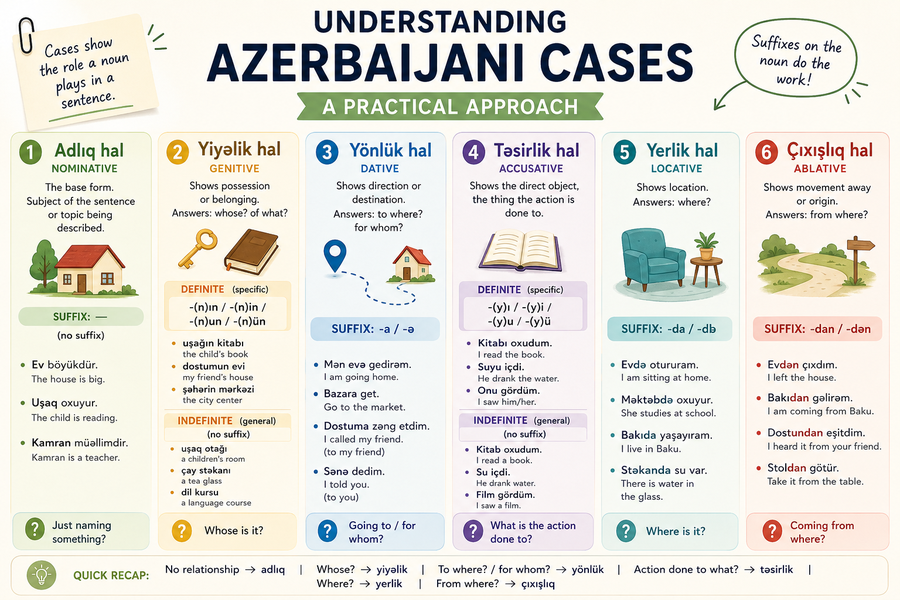
The question to ask yourself
When you are not sure which case to use, a quick way to find it:
- No relationship, just naming something → adlıq (no suffix)
- Whose is it? → yiyəlik (-ın/-in or no suffix depending on definiteness)
- Going to / for whom? → yönlük (-a/-ə)
- What is the action done to? → təsirlik (-ı/-i or no suffix depending on definiteness)
- Where is it? → yerlik (-da/-də)
- Coming from where? → çıxışlıq (-dan/-dən)
The cases are not arbitrary. Each one encodes a relationship that English expresses through separate prepositions or word order. Once you map the logic, the suffixes become the easier part. What you are really learning is how Azerbaijani organizes meaning; and that is the same across every sentence you will ever encounter.
Use this cheat sheet as a quick reference while you practice. Start with the question each case answers, then choose the suffix.
Practice Cases in Real Sentences
Cases are easiest to learn when they appear inside real phrases rather than grammar charts in isolation. The Master Azerbaijani app builds grammar into everyday sentences from the beginning.