
Food is one of the fastest ways into a language. Not because it is easy, but because the stakes are low and the rewards are immediate. You learn the word for something, you say it, and someone brings you that thing. The feedback loop is about as clean as language learning gets.
Azerbaijani food culture also gives you a lot to work with. Meals are social, generous, and often long. There is vocabulary for ordering in a restaurant, vocabulary for what happens in someone’s kitchen, and a whole register of expressions for showing appreciation, which, in Azerbaijani hospitality, is not optional.
At the restaurant
The basics come first. When you sit down, you will likely be handed a **menyu"" (menu). When you are ready, you sifariş ver, i.e., place an order. At the end, you ask for the hesab (bill).
A few phrases that will carry you through most restaurant situations:
- Menyu, zəhmət olmasa. - The menu, please.
- Sifariş vermək istəyirəm. - I would like to order.
- Bu nədir? - What is this?
- Siz nə tövsiyə edirsiniz? - Do you recommend anything?
- Hesab, zəhmət olmasa. - The bill, please.
That last phrase, zəhmət olmasa is worth internalizing early. It means please and softens almost any request. The sister version of it is xahiş edirəm, which carries a sharper edge. It’s the please you reach for when asking someone to stop doing something, move something, or leave something out. Less of a softener, more of a direct instruction wrapped in politeness.
If you are traveling and want to go beyond the basics, these traveler phrases cover more of the practical ground you will actually need on arrival.
The dishes worth knowing by name
You do not need to memorize every item on every menu. But knowing a handful of staples means you can order with some confidence and understand what is being described to you.
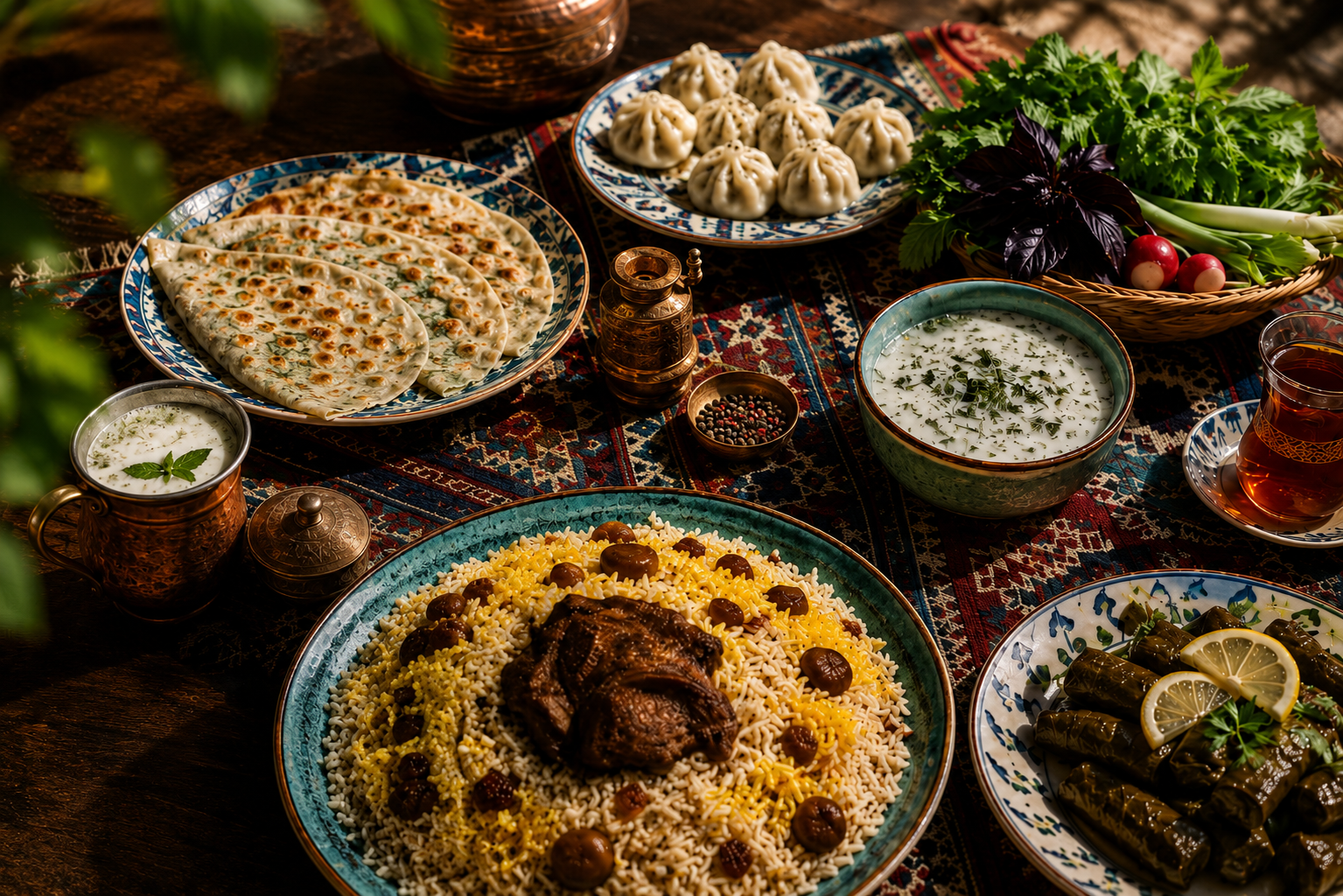
Plov is the one that comes up most. A rice dish cooked with saffron, dried fruit, and often lamb; it is central enough to Azerbaijani cuisine that there are dozens of regional variations. If you are invited somewhere for a special meal, plov is likely involved. The elevated version is called şah plov (aka king plov).
Dolma refers to stuffed vegetables; grape leaves, peppers, or tomatoes filled with a spiced meat and rice mixture. The word itself comes from the verb doldurmaq, to fill.
Qutab is a thin flatbread folded around a filling, typically greens, meat, or pumpkin, and cooked quickly on a griddle. It is street food as much as it is home food.
Düşbərə are small dumplings served in broth; closer to a starter or light meal than a main.
Bozbaş is a lamb-based soup, hearty and deeply savory, the kind of thing that shows up in cold months and at family tables.
Dovğa is a yogurt-based soup cooked with fresh herbs and a little bit of rice or chickpea, and one of the few dishes that works equally well hot or cold.
Paxlava and şəkərbura are the sweets most associated with celebrations, especially Novruz. If someone offers you either, saying no is genuinely unusual. Şəkərbura is an acquired taste and not really my thing, but Azerbaijani paxlava is a different story! You do not want to miss it!
In the kitchen
If you are cooking with someone, or following a recipe, a few verbs go a long way:
- bişirmək - to cook
- qovurmaq - to fry or roast
- doğramaq - to chop
- qarışdırmaq - to mix or stir
- əlavə etmək - to add
Useful nouns to pair with them:
- yağ - oil or butter
- duz - salt
- istiot - pepper
- soğan - onion
- sarımsaq - garlic
- su - water
Recipes in Azerbaijani tend to be loose with quantities; bir az (a little) and lazım olan qədər (as much as needed) appear constantly. If you are cooking alongside someone rather than following a written recipe, just watch the hands.
Complimenting the food
This is where the vocabulary gets genuinely interesting, because Azerbaijani has expressions for appreciating a meal that do not translate cleanly into English.
The most important one is Əlinizə sağlıq, literally health to your hands. You say it to whoever cooked. It is not a casual compliment; it is a proper acknowledgment, and skipping it after a home-cooked meal would be noticed.
A few others:
- Çox dadlıdır. - It is very delicious.
- Əla bişiriblər. - It has been cooked wonderfully.
- Doydum, təşəkkür edirəm. - I am full, thank you. (Said to signal you have eaten well; a compliment in itself.)
The phrase Nuş olsun functions like bon appétit - said before eating, or to someone who is eating. You will hear it constantly. Responding with Sağ olun (thank you, roughly) is perfectly natural.
Food and hospitality are so tightly woven together in Azerbaijani culture that the vocabulary overlaps more than you might expect. The language of Azerbaijani hospitality goes deeper into how this plays out, not just at the table, but in how guests are received and what is expected on both sides.
A note on tea
No food vocabulary post for Azerbaijan is complete without this: the meal does not end when the food does.
Çay (tea) comes after (and even before). Always. It arrives in small pear-shaped glasses called armudu (named for their shape, armud meaning pear), usually with sugar on the side rather than stirred in. Refusing tea after a meal is possible, but it is the kind of refusal that requires a reason.
Saying Çay içərik? (Shall we have tea?) is less a question and more an announcement of what happens next.
The vocabulary will come faster than you expect
Food words stick because you encounter them repeatedly and in context. You read the menu, you hear the dish described, it arrives, you eat it, and you comment on it. That cycle, i.e., word, context, use, and feedback, is exactly how vocabulary moves from recognition into actual use.
Start with the phrases you will need most: ordering, asking what something is, and saying it was delicious. The rest builds from there.
Nuş olsun.
Keep Practicing Real Azerbaijani
Food vocabulary is useful because you can use it immediately: ordering, asking what something is, thanking the host, and complimenting the meal.
If you want to keep building practical Azerbaijani step by step, start with the free first module in the Master Azerbaijani app. It gives you the foundation first, then moves into greetings, real phrases, grammar, and everyday communication.