
So you’ve decided to learn Azerbaijani. Maybe you’re planning a trip to Baku, reconnecting with family roots, want to impress your Azerbaijani partner, or you just got tired of smiling politely when your relatives speak, and praying nobody asks you a question. Whatever brought you here, you’re probably wondering:
What am I getting myself into?
Here’s the honest version: learning Azerbaijani as an adult comes with very real challenges, and some ridiculously rewarding moments you can’t get from any other language.
Let’s get into it.
The Good News: Azerbaijani Is More Accessible Than You Think
1. The alphabet won’t melt your brain
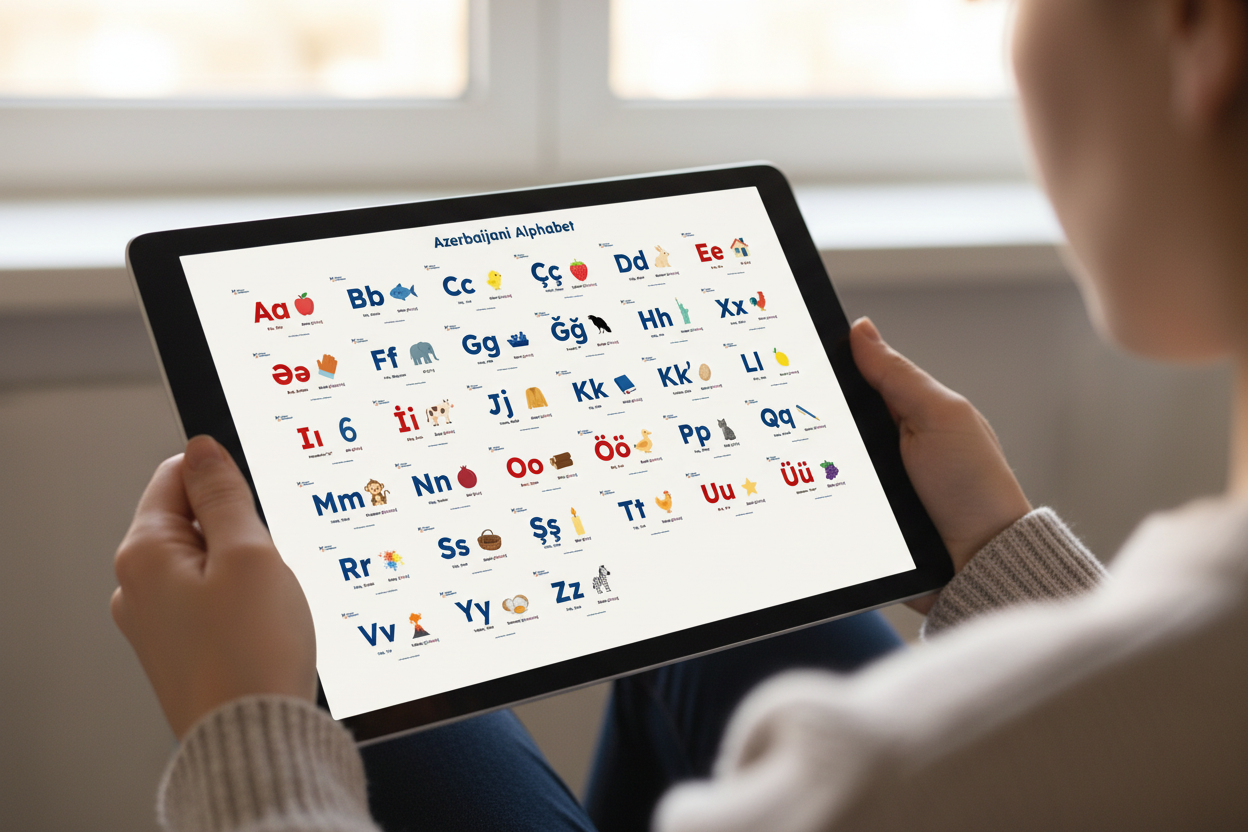
Since 1991, the Azerbaijani language uses a Latin-based alphabet with 32 letters. If you can read English, you’re already 60% in the door.
Yes, you’ll meet new friends like ə, ğ, ş, ö, ü, but they follow consistent rules.
If you want a quick crash course, read Azerbaijani Alphabet Made Easy. It covers everything without wasting your time.
2. Pronunciation is predictable
Azerbaijani is phonetic. What you see is (mostly) what you say.
If pronunciation stresses you out, start with The Secret to Perfect Azerbaijani Pronunciation (It’s Not What You Think). It’ll save you months of trial and error.
3. Grammar is logical, not chaotic
Azerbaijani builds words with suffixes piled on like Lego pieces. It looks scary until you realize the system is surprisingly consistent.
Learn a suffix once → use it everywhere.
The Reality Check: Where You’ll Struggle
1. Word order feels backwards
Azerbaijani is an SOV language (Subject→Object→Verb), which means the verb usually comes at the end of the sentence. Your English brain (or any first language that uses SVO word order) will fight this for a while.
2. Suffixes will gang up on you
That nice, logical system can create monsters like:
evlərimizdəkilərdən
from those in our houses
Logical? Yes.
Comfortable? Not at first.
3. Resources aren’t everywhere
Azerbaijani isn’t Spanish or Mandarin. You’ll need to do more research to find high-quality content.
If you want engaging alternatives, try How to Learn Azerbaijani Without Boring Textbooks.
4. Speaking practice isn’t handed to you
Unless you have Azerbaijani relatives or live in Azerbaijan, real conversation practice won’t magically appear.
If you want structured speaking practice that doesn’t feel chaotic or random, Join our waitlist. You’ll be the first to know when guided speaking exercises, pronunciation feedback, and real-life dialogues go live.
Until then, explore language exchange options on your own and keep your exposure high.
The Timeline (Realistic, Not the Cute Version)
0–3 months
- Alphabet
- Basic greetings
- Simple present tense
- Order food
- Ask directions
- ~300–500 words
- Heavy translating in your head
6 months
- Daily-life conversations
- Core grammar patterns
- ~1,000 words
- Still translating, but faster
- “Necəsən?” stops scaring you
- Speed this up with How to Think in Azerbaijani (Not Translate from English)
12 months
- Intermediate level
- Read simple texts
- Past/future tenses
- Conversations flow (slowly)
18–24 months
Conversational fluency for most adults.
3–4 years
Professional proficiency (depends on intensity + immersion).
Strategies That Actually Work
Skip perfectionism
Adults obsess over suffix order and accuracy. It slows you down.
Speak early. Fix later.
Immerse creatively
- Daily 30-second self-talk in Azerbaijani
- Follow Azerbaijani social media accounts/pages
- Watch shows
- Listen to songs
Micro-exposure compounds over time.
Focus on high-frequency words
Top 1,000 words = 80% of everyday conversation.
Use spaced repetition
Five minutes a day beats weekend cram sessions.
Get a language partner early
- Do it before you feel “ready.”
Don’t wait until you think your Azerbaijani is “good enough” to talk to someone. Start early, even when you’re terrible.
For everyday habit ideas:
Practice Azerbaijani Daily: Effortless Habits That Actually Work
The Unexpected Benefits
1. Cultural access at a deeper level
You’ll understand jokes, expressions, tea culture, and family dynamics. The stuff Google Translate will never teach you.
2. Cognitive flexibility
Agglutinative languages reshape how your brain organizes ideas. You’ll feel the shift.
Note: Agglutinative languages build meaning through stacked suffixes, not separate words.
3. The community genuinely roots for you
Azerbaijanis appreciate effort.
They’ll encourage you, help you, correct you gently, and sometimes overfeed you.
Managing Your Adult Learner Brain
Your adult brain is an asset, not a liability.
- You can analyze patterns
- Make connections
- Ask better questions
- Notice structure
- Learn intentionally
Just don’t let perfectionism suffocate progress.
Mistakes aren’t failure! They’re valuable feedback.
Is It Worth It?
Yes! Not because it’s easy, but because it’s meaningful.
The moment you manage to say “Salamatçılıqdır” and see someone’s face light up… you’ll know exactly why you’re doing this.
It’s the warmth you get when someone hears you try.
It’s the pride of reading an article without constantly checking a dictionary.
It’s the satisfaction of forming a sentence without translating first.
It’s the connection to a culture that actually wants you to succeed.
Languages give you communication.
Azerbaijani gives you communication plus belonging.
If the journey calls to you:
Xoş gəlmisiniz. Welcome.
Your first word is already done.