
Languages do not change on their own when power is involved.
They are adjusted, redirected, and sometimes forcibly rewritten.
Azerbaijani did not simply “develop” during the Soviet period.
It was selectively reshaped. But to understand how, we need to step back.
Before Soviet Rule: An Unfinished Language Project
When Azerbaijan briefly became an independent republic in 1918, the goal was not only political independence.
The Azerbaijan Democratic Republic (ADR) lasted just twenty-three months, but it was ambitious. Education was reformed. Institutions were built. Social structures were questioned. Language was part of that transformation.
For the first time, Azerbaijani was declared the state language. Intellectuals debated how it should be taught, standardized, and written. Questions about literacy, education, and script reform were already on the table.
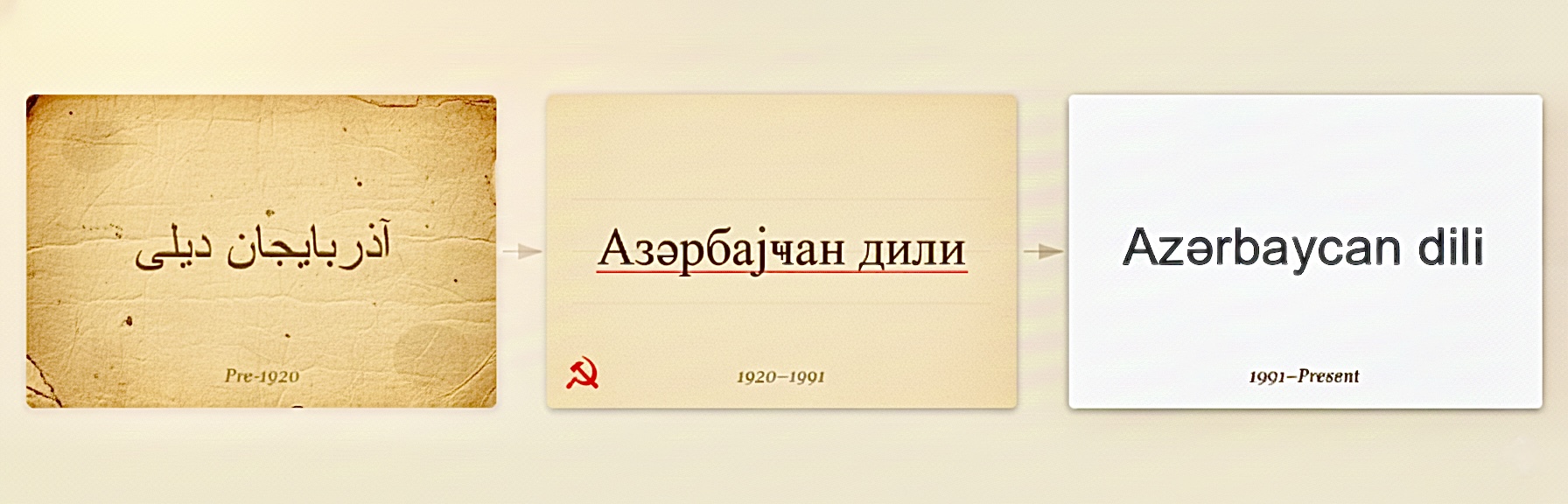
Before the twentieth century, Azerbaijani had not functioned as a fully standardized state language in the modern sense. Under the Russian Empire, Russian was the administrative language, while Azerbaijani was widely used in literature, journalism, education, and everyday writing by intellectuals. It was typically written in an Arabic-based script, following long-standing literary and cultural conventions rather than centralized regulation.
Unfortunately, the ADR did not survive long enough to implement large-scale language reform. In 1920, the Red Army entered Azerbaijan, and Soviet rule was imposed.
What followed was not the birth of language reform, but the takeover of an unfinished one.
Soviet Rule and Language Control (1920–1991)
Between 1920 and 1991, Soviet rule reshaped how Azerbaijani was written, which forms were promoted, which words carried prestige, and what kind of speech sounded educated or authoritative.
The spoken language continued to evolve naturally.
But its institutional form was carefully managed.
If Azerbaijani sometimes feels formal, rigid, or inconsistent to learners today, this history explains why.
Script Changes Were Never Neutral
Script changes were not about convenience or clarity.
They were also about control.
In the 1920s, a Latin-based alphabet was introduced as part of a Soviet-wide modernization and secularization campaign. Many local intellectuals initially supported the reform, hoping it would increase literacy and modernize education.
However, the shift disrupted continuity. For educated readers, access to earlier written material became increasingly difficult within a generation.
In 1939, the alphabet was changed again; this time to Cyrillic.
This was the decisive move.
Cyrillic aligned Azerbaijani with Russian, distanced it from other Turkic languages, and tied literacy directly to Soviet education. Entire generations experienced multiple script changes in a single lifetime.
Literacy was no longer a continuity.
It was reset.
Russian Words Entered Institutional Azerbaijani
Soviet life required Soviet terminology.
Administration, industry, education, science, and bureaucracy operated primarily through Russian. Azerbaijani absorbed this vocabulary deeply, especially in formal contexts.
Words such as:
- direktor
- institut
- protokol
- fabrika
- pensiya
became part of everyday usage.
Even when Azerbaijani alternatives existed, Russian-based terms were often treated as more official or correct.
This created a split that still exists:
- Home Azerbaijani
- Institutional Azerbaijani
Formal Style Became Dominant in Public Life
Azerbaijani has always had multiple registers, from informal spoken language to highly formal written styles. Complex sentence structures and impersonal forms existed long before the Soviet period.
What changed was not the grammar itself, but which register was privileged.
Education, administration, and official communication increasingly favored a formal, impersonal style shaped by bureaucratic norms and influenced by Russian administrative language. Nominalized expressions and indirect phrasing became common in institutional settings.
For example, both of the following are valid Azerbaijani:
Everyday speech:
- “Sənədləri sabah gətir.”
Formal, administrative style:
- “Sənədlərin sabah təqdim edilməsi xahiş olunur.”
The difference is not correctness, but register.
Because Soviet-era education emphasized formal written norms, this style became overrepresented in textbooks and official materials. As a result, learners often encounter Azerbaijani first through structures that sound unnatural in everyday conversation.
Education Enforced One “Correct” Azerbaijani
The Soviet system valued uniformity.
Regional expressions, dialects, and local speech patterns were discouraged in favor of a single standardized form. Over time:
- Dialects weakened
- Oral richness declined
- Formal speech dominated education
Many learners notice that real conversations sound different from what they learned first.
That gap is historical, not accidental.
Russian Became a Tool for Social Stratification
Under Soviet rule, language was not just a means of communication.
It became a marker of social position.
Azerbaijani was widely spoken in everyday life and at home. Russian dominated higher education, science, administration, and military careers. Access to professional advancement often required fluency in Russian.
Over time, this produced a damaging hierarchy.
Speaking Russian came to signal education and authority. Speaking Azerbaijani, especially outside a narrow standardized form, was increasingly framed as informal or insufficient for “serious” contexts.
This hierarchy was not natural.
It was taught.
Some speakers internalized the idea that Azerbaijani alone was not enough. In extreme cases, neither language was spoken well, yet Russian affiliation itself was treated as a social upgrade.
Even decades later, this mindset surfaces in attitudes toward accented Azerbaijani, unnecessary Russian requirements in local job postings, and assumptions about professionalism.
Knowing multiple languages is an advantage.
But no language makes a speaker superior.
There is also a simpler truth that often gets ignored.
Azerbaijan is Azerbaijan. Azerbaijani is the public language of the country. It should be expected, required, and respected in education, work, and everyday professional life.
Other languages are valuable skills. They expand access, opportunity, and perspective. But they are additions, not substitutes, and certainly not markers of social worth.
Azerbaijani is not a lower-class language. It was treated that way.
Unlearning that belief is long overdue.
Language should measure competence, not class.
After Independence, the Language Did Not Reset
In the 1990s, Azerbaijan returned to a Latin script and consciously moved away from Soviet linguistic norms.
But languages do not reboot overnight.
What remained:
- Soviet-era vocabulary
- Formal institutional habits
- Generational differences in speech
Modern Azerbaijani did not emerge from a single source.
It is a Turkic language at its core, enriched by Persian literary tradition and later influenced by Russian through education and administration. Each layer left traces that are still visible in how the language sounds, looks, and functions today.
In the next post, How Turkic, Persian, and Russian Shaped Modern Azerbaijani, I’ll look more closely at how these influences coexist, and how learners can recognize them without confusion.
What This Means for Learners
If you are learning Azerbaijani today:
- You will hear multiple versions of the same idea
- Older speakers may sound more formal
- Younger speakers are often more concise and Turkic
- Textbooks may reflect Soviet-era structure
None of this is incorrect.
It is history speaking through language.
What History Leaves Behind
Soviet rule did not erase Azerbaijani.
But it edited the language heavily.
Azerbaijani survived, adapted, and moved forward, carrying those edits with it.
Understanding that history makes the language easier to learn, not harder. Once you see where certain structures, registers, and habits came from, modern Azerbaijani starts to make more sense.
Keep Learning the Language in Context
If you are learning Azerbaijani today, it helps to study the language as it is actually used: not just formal textbook Azerbaijani, and not just isolated vocabulary.
The Master Azerbaijani app starts with the foundations, then builds toward real phrases, grammar, pronunciation, cultural context, and everyday communication step by step.