
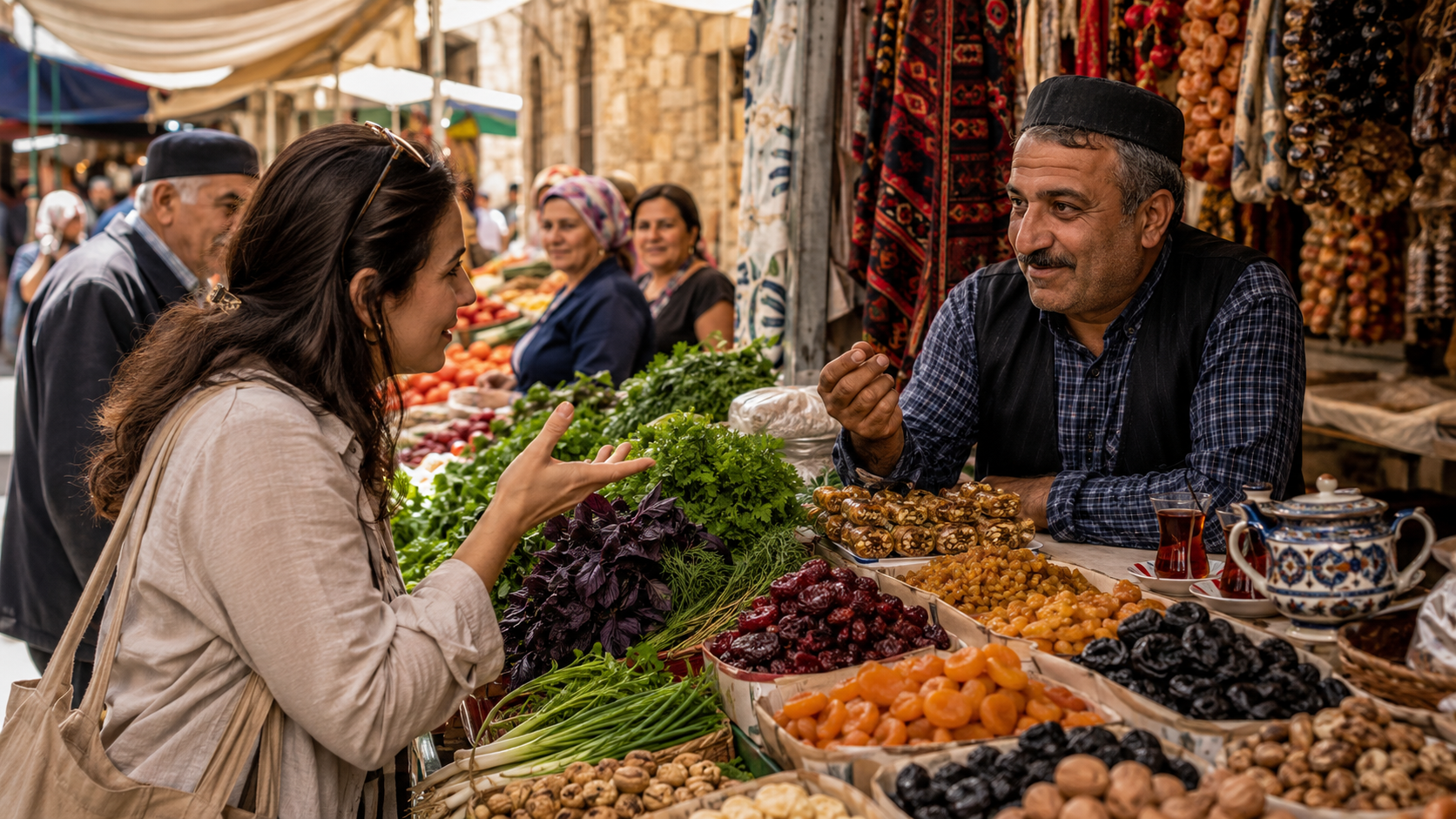
In Azerbaijan, the first price is rarely the final one.
Not at the bazaar. Not when buying a carpet. Not when negotiating a car, a house, or a service. The back-and-forth is not awkward; it is expected. Skipping it is the unusual move.
This is not about being cheap or difficult. It is a social exchange. It signals that you are engaged, that you respect the process, and that you are someone worth doing business with. Accepting the first price without a word can actually feel off to the seller.
If you are visiting Azerbaijan, or living there, knowing how to haggle in Azerbaijani changes the experience entirely. Not just because you might pay less, but because you are participating in something real instead of watching from the outside. If you have not covered the basics yet, start with 5 Common Phrases for Travelers to Azerbaijan first; this post builds on that foundation.
Start with the price
Before anything else, you need to know what you are dealing with.
Bu neçəyədir? - How much is this?
[Bu ne-çə-yə-dir]
That is your opening line for almost any situation. Simple, direct, works everywhere.
If you are looking at multiple things or want to ask about everything together:
Hamısı neçəyədir? - How much is all of it?
[Ha-mı-sı ne-çə-yə-dir]
And if the price surprises you:
Niyə bu qədər bahadır? - Why is it so expensive?
[Ni-yə bu qə-dər ba-ha-dır]
Say it genuinely curious, not accusatory. Tone carries everything here.
React to the price
You have heard the number. Now you respond.
Bahadır. - It’s expensive.
[Ba-ha-dır]
Just that. No drama. Said calmly, it opens the negotiation naturally.
Çox bahadır. - It’s very expensive.
[Çox ba-ha-dır]
A little more emphasis when the gap is large.
Heç ucuz deyil. - It’s not cheap at all.
[Heç u-cuz de-yil]
Softer version. Acknowledges the price without pushing hard.
What you are doing here is not complaining. You are signaling that you are in the conversation. The seller knows what comes next.
Make your move
Bir az endirim edə bilərsiniz? - Can you give a little discount?
[Bir az en-di-rim e-də bi-lər-si-niz]
This is the standard, polite way to open the negotiation. It is direct without being aggressive.
Ən son qiymət nədir? - What is your best price?
[Ən son qiy-mət nə-dir]
This one may not move things along faster. But if you are serious and ready to decide, worth a shot.
Bir az da endirim edin. - Give me a little more discount.
[Bir az da en-di-rim e-din]
Softer ask. Works well when the gap between you is not large.
If you have a number in mind:
… manata verərsiniz? - Will you give it for … manat?
[… ma-na-ta ve-rər-si-niz]
Fill in your number. Keep it reasonable. Coming in too low reads as not serious.
Slow things down
Sometimes you need a moment. Either to think, or to let the silence do its work.
Bir az fikirləşim. - Let me think about it.
[Bir az fi-kir-lə-şim]
Baxım da. - Let me have a look.
[Ba-xım da]
Walking away or appearing to, is one of the oldest moves in negotiation. In Azerbaijani markets it is completely normal. If the seller calls you back, you have more room than they showed at first.
Close it
You have gone back and forth. You are close.
Razıyam. - I agree. / I’m fine with that.
[Ra-zı-yam]
Oldu. - Done. / Agreed.
[Ol-du]
Alıram. - I’ll take it.
[A-lı-ram]
Short, clear, final. Once you say oldu, the deal is made. Do not try to renegotiate after.
A few things worth knowing
Cash still moves faster than cards in many places. Having small bills matters; sellers do not always have change, and Xırda var? (Do you have change?) is a useful phrase to know.
If a seller will not move at all on price, they usually mean it. Not every number is negotiable by the same amount. A carpet seller has more room than a bread vendor.
And if you are buying something significant, a carpet, a piece of jewelry, anything with real craft behind it, take your time. Rushing signals that you do not value what you are looking at, which is its own kind of wrong move.
The phrases are the easy part. The rest is paying attention to the person in front of you. Understanding Azerbaijani Hospitality Through Language gives useful context for reading those social cues correctly.
Practice Before You Go
The Master Azerbaijani app builds toward real phrases, numbers, and everyday transactions step by step; so when you arrive, the language is already there.